
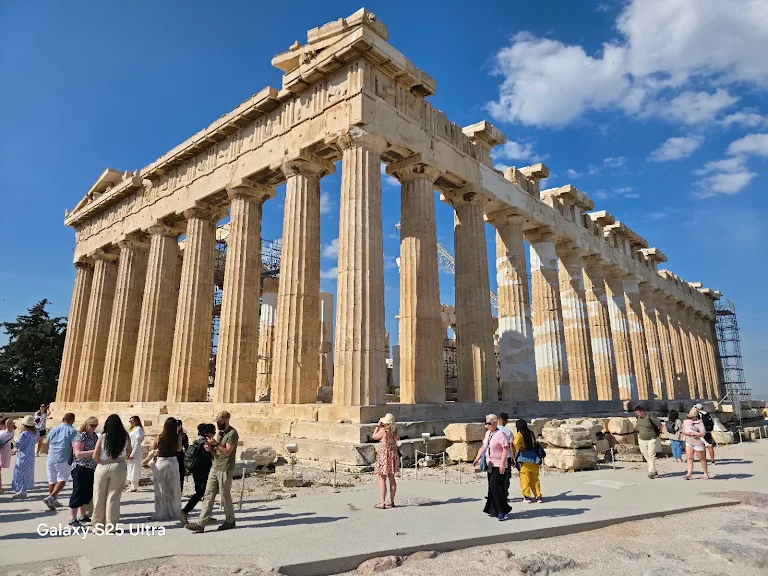
Rising majestically above the historic city of Athens, the Acropolis is one of the most famous archaeological sites in the world and a powerful symbol of ancient Greek civilization. With its magnificent temples, remarkable architecture and breathtaking views, this ancient citadel attracts millions of visitors every year who come to experience one of the greatest treasures of European history.
For anyone visiting Athens, exploring the Acropolis is an unforgettable experience. It offers a unique opportunity to walk through thousands of years of history while discovering the birthplace of some of the most influential ideas in Western civilization.
What Is the Acropolis of Athens?
The word Acropolis comes from two ancient Greek words: akron, meaning highest point, and polis, meaning city. The Acropolis was therefore the fortified upper part of an ancient city, usually built on a hill to provide protection and a strategic advantage.
The Acropolis of Athens stands on a rocky limestone hill approximately 156 meters above sea level. Although the hill has been inhabited since prehistoric times, it became particularly important during the fifth century BC, when Athens experienced a remarkable period of political, cultural and artistic development.
Today, the Acropolis is recognized as a UNESCO World Heritage Site and remains one of Greece’s most important national landmarks.
The Parthenon: The Most Famous Temple in Greece
The most recognizable building on the Acropolis is undoubtedly the Parthenon, an extraordinary temple dedicated to Athena, the patron goddess of Athens.
Construction began in 447 BC during the leadership of Pericles and was largely completed by 438 BC. The architects Ictinus and Callicrates designed the temple, while the celebrated sculptor Phidias supervised its artistic decoration.
Built primarily from beautiful white Pentelic marble, the Parthenon is considered one of the finest examples of classical Greek architecture.
Its impressive columns, carefully calculated proportions and detailed sculptures demonstrate the extraordinary engineering and artistic abilities of ancient Greek craftsmen.
Although the building has suffered damage over the centuries, including an explosion in 1687, its remains continue to dominate the Athens skyline.
Other Important Monuments on the Acropolis
While the Parthenon receives most of the attention, several other remarkable monuments make the Acropolis an extraordinary archaeological destination.
The Erechtheion
The Erechtheion is one of the most distinctive buildings on the Acropolis. Built between approximately 421 and 406 BC, it is famous for its southern porch, where six sculpted female figures known as the Caryatids replace traditional columns.
The original Caryatids are now preserved in museums, including the Acropolis Museum, while replicas stand at the monument.
The Temple of Athena Nike
Located near the entrance to the Acropolis, this elegant Ionic temple was dedicated to Athena Nike, the goddess associated with victory.
Built during the fifth century BC, the small but beautifully proportioned structure celebrated Athens’ military achievements and the city’s relationship with its protective goddess.
The Propylaea
The Propylaea is the monumental gateway to the Acropolis. Designed by the architect Mnesicles, it was constructed between 437 and 432 BC.
Its impressive marble architecture creates a dramatic entrance to the ancient sanctuary and provides visitors with their first glimpse of the extraordinary monuments inside.
The Theatre of Dionysus
Situated on the southern slope of the Acropolis, the Theatre of Dionysus is considered one of the earliest important theatres in the ancient Greek world.
It played a major role in the development of Greek drama, where the works of famous playwrights such as Sophocles, Euripides and Aristophanes were performed.
The History of the Acropolis
The history of the Acropolis stretches back thousands of years, long before the famous temples were constructed.
During the Mycenaean period, the hill served as an important fortified settlement. Over time, it developed into a major religious center dedicated primarily to Athena.
The fifth century BC marked the golden age of the Acropolis. Following the Persian destruction of Athens in 480 BC, the city undertook an ambitious rebuilding program under Pericles.
This period produced some of the greatest architectural achievements of ancient Greece, including the Parthenon and the Erechtheion.
During the Roman and Byzantine periods, the Acropolis continued to serve religious and political purposes. The Parthenon was eventually converted into a Christian church.
Under Ottoman rule, the building became a mosque. In 1687, during a Venetian siege of Athens, an explosion destroyed much of the Parthenon’s interior after gunpowder stored inside ignited.
Following Greek independence in the nineteenth century, extensive archaeological work began to restore and preserve the ancient monuments.
Today, conservation specialists continue working to protect the site for future generations.
Visiting the Acropolis: What Tourists Should Know
The Acropolis is located in the center of Athens and is relatively easy to reach from many parts of the city.
The closest metro station is Acropoli on Line 2, just a short walk from the main archaeological entrance.
Visitors can also reach the site on foot from popular neighborhoods such as Plaka, Monastiraki and Koukaki.
Walking up the archaeological hill involves uneven stone paths and some steep sections, so comfortable shoes are strongly recommended.
During summer, temperatures in Athens can become extremely high. Visiting early in the morning or later in the afternoon is generally more comfortable than arriving around midday.
It is also advisable to bring drinking water, sunscreen and a hat, particularly during July and August.
How Much Time Do You Need?
Most visitors spend approximately two hours exploring the Acropolis itself, although history enthusiasts and photography lovers may prefer to stay longer.
Allow additional time if you plan to visit the Acropolis Museum, which is located nearby and contains many original sculptures and archaeological discoveries from the site.
A visit to both attractions provides a much deeper understanding of the history, architecture and artistic achievements of ancient Athens.
The Acropolis Museum: A Treasure Beneath the Ancient Hill
Located near the archaeological site, the Acropolis Museum is one of the most impressive museums in Greece.
Its modern architecture provides a striking contrast with the ancient monuments nearby. Inside, visitors can discover original sculptures, decorative elements, archaeological objects and fascinating artifacts recovered from the Acropolis.
One of the museum’s most remarkable attractions is the collection of original Caryatids from the Erechtheion.
The museum’s upper Parthenon Gallery is particularly impressive because its layout follows the dimensions and arrangement of the original temple’s sculptural decoration.
Large glass windows also offer beautiful views of the Acropolis, allowing visitors to admire the ancient monument while exploring its history.
The Best Views of the Acropolis
The Acropolis is not only an extraordinary archaeological destination but also one of the most photogenic landmarks in Europe.
Several locations around Athens provide spectacular views of the ancient hill.
-Areopagus Hill: One of the closest and most popular viewpoints, offering wonderful views of the Parthenon.
- Philopappos Hill: A beautiful green area with panoramic views across Athens and the Acropolis.
- Lycabettus Hill: The highest central hill in Athens, offering an impressive perspective of the entire city.
- Plaka: The historic neighborhood below the Acropolis provides charming streets and picturesque views of the ancient monument.
Sunset is particularly beautiful, when the golden light illuminates the marble structures and creates wonderful photography opportunities.
The Acropolis at Night
The Acropolis becomes especially magical after sunset, when its ancient monuments are illuminated against the Athens night sky.
The illuminated Parthenon can be admired from numerous locations throughout the city, including restaurants, rooftop bars and public viewpoints.
For many visitors, seeing the Acropolis at night is just as memorable as exploring the archaeological site during the day.
The contrast between the ancient monument and the modern city surrounding it offers a fascinating perspective on Athens, a capital where thousands of years of history remain part of everyday life.
Why the Acropolis Is a Must-Visit Attraction in Athens
The Acropolis is much more than a collection of ancient ruins. It represents the extraordinary achievements of a civilization that influenced architecture, philosophy, democracy, theatre, art and science.
Walking among its temples provides a connection with a distant historical period that continues to shape the modern world.
Whether you are interested in ancient history, architecture, archaeology or photography, the Acropolis offers something truly special.
No visit to Athens would be complete without discovering this magnificent monument, standing proudly above the Greek capital as a timeless reminder of the greatness of ancient Greece.
About the Author